
Growing up I was taught and always believed that the Cape of Good Hope is the southernmost tip of Africa. I have been disabused all my life. It took until I reached my 73rd year and actually traveled here that I learn the truth. Cape Agulhas, located about 220 kms east southeast is actually the point where the waters of the Two Oceans , the Atlantic and the Indian, meet. Early Mariners sought refuge in the seemingly protected waters of Table Bay. That is until the winter months of the Southern Hemisphere, July, August and September when the south easterly gales blow. If the commentary on the tour bus is to be believed, there are about 2700 ship wrecks in these waters although another source suggested the number is actually 650 over the last 400 years.
Speaking of tour buses, Vicki and I have enjoyed the hospitality of the big red double decker buses known in over 100 cities around the world as the Hop On Hop Off City Tours, affectionately known as the HOHO. We have ridden these buses in Mexico City, Guadalajara, Sidney Australia, New York City to name a few. A great way to see a new place and meet interesting people. Cape Town is no exception.
After a flight from Joberg Monday morning we landed and Ubered to our home the next 6 nights, a great Airbnb apartment in Sea Point, one of southern suburbs of Cape Town. We are two blocks from the Sea Point Promenade which stretches from the Victoria and Alfred waterfront to Sea Point. We boarded the bus red bus and spent the day traveling throughout the city, from said V&A waterfront to the Central Business District, over the other side of Signal Hill and Lion’s Head. There are actually 3 routes for the HOHO here in Cape Town, one of which takes you up through wine country with stops at 3 different wineries. We alighted at Groot Constanta, the oldest winery in South Africa. With vines planted in 1685 it has been producing and exporting wines for kings and emperors and everyday folk ever since. We enjoyed a great lunch on the grounds of the old manor house which is now a museum with the nearby slave quarters serving as the restaurant and art gallery. After a glass of Pinotage enjoyed by Vicki we resumed the bus trip. Next we ventured into Hout Bay and Camps Bay further south along the coast. The former is a mixed residential area with tin shacks for the less fortunate population stretching up the hillsides, a large marina and dock ares at the water front and it’s very own Lichtenstein Castle perched high upon Rhodes Mtn overlooking the bay. Heading back closer to town, we pass through Camps Bay, a very upscale neighborhood of expensive apartments and homes nestled along the seashore. Beautiful setting. Sandy beaches and sparkling blue water on one side of the bus and trendy shops and restaurants on the other side. We stopped and got a cappuccino for Vicki and a chai tea for me and walked the beach, enjoying the suntanners and beach vollyballers.
Back on the bus we continued our journey and soon we’re back at the V & A waterfront. As it was now approaching 5:30 we boarded another bus for the sunset tour. This is a different route that takes you up to the top to Signal Hill, a landmass in the shadow of Table Mountain. Here along with 100’s of other tourists we watched as the sun sank in the western Atlantic. As the iconic south easterly wind was blowing we huddled in the enclosed part of the bus to stay warm. Now in full darkness we headed back to the V & A waterfront and then an Uber home.
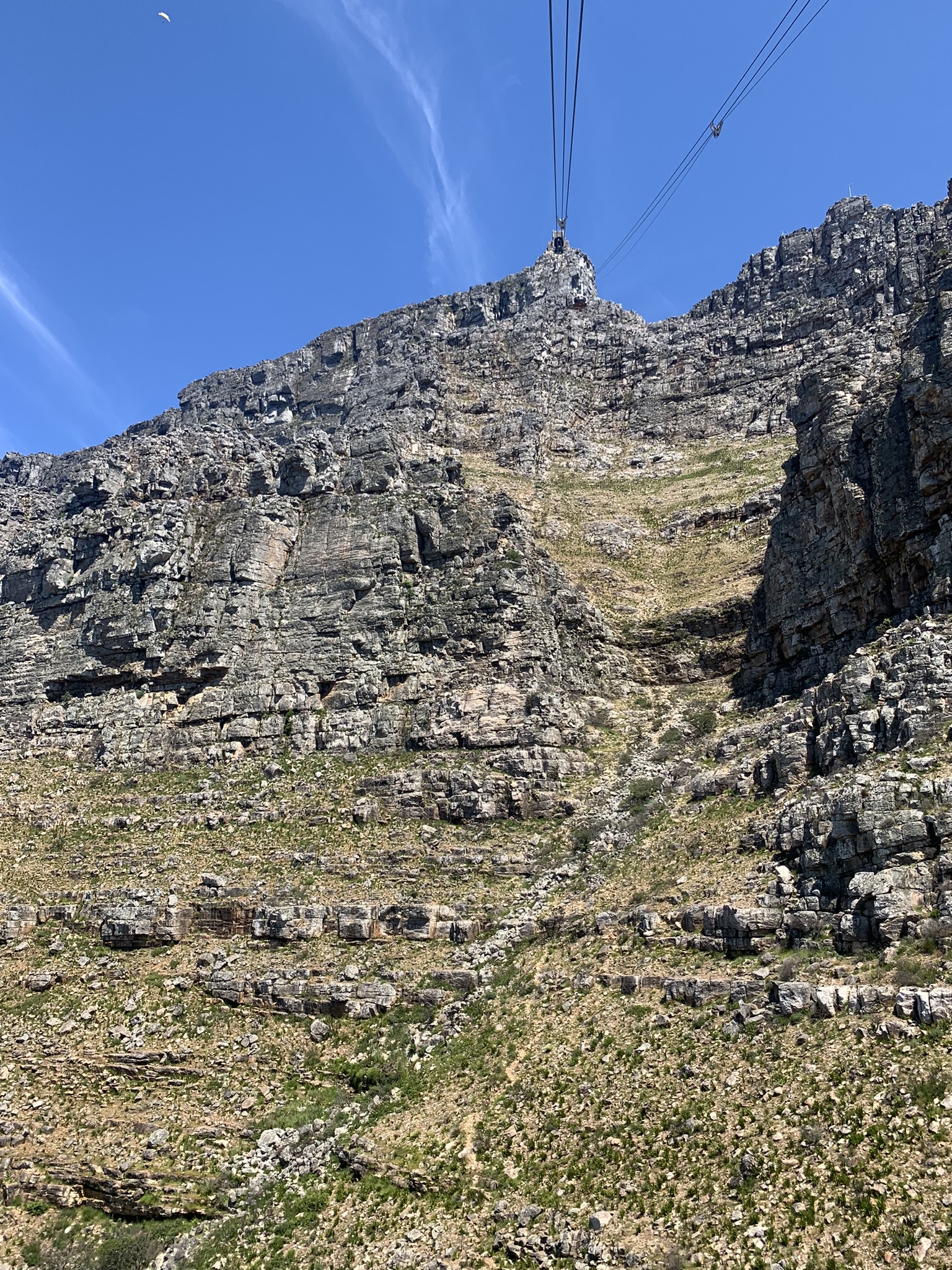
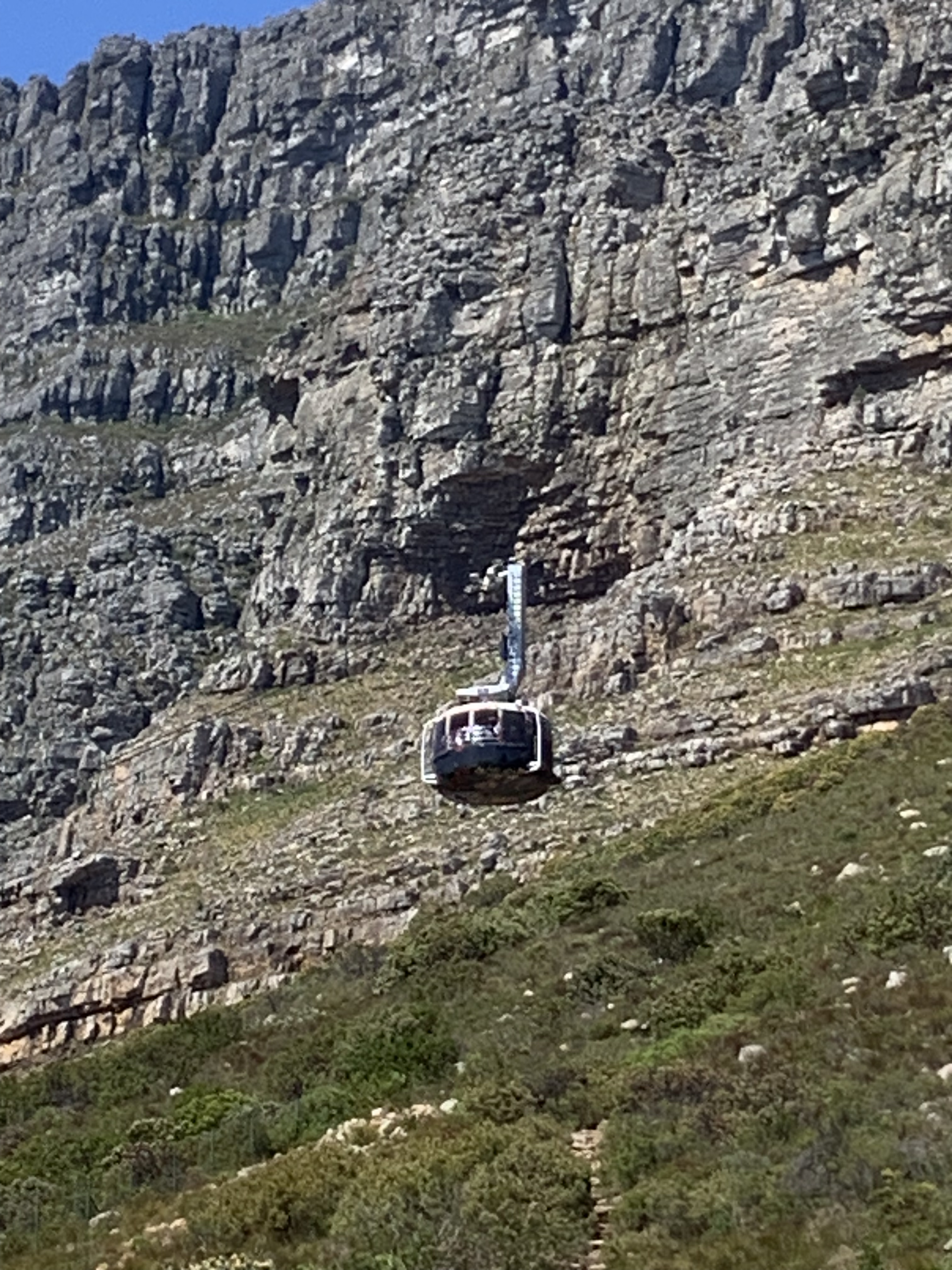
Today we got on the bus again for the tour up Table Mountain. This iconic geological feature dominates the Cape Town skyline. At 1067 meters or almost 3500 feet, the summit is reached by a two car aerial tramway. This is third most popular tourist attraction in all of Africa and attracts about 1,000,000 visitors per year. I’m sure 100,000 of them were there today. It took us almost 2 hours just to reach the loading platforms. The trip up takes about 4 minutes and the car hold 62 people. While the car is in motion the floor turns so everyone gets a chance to see the view. And stunning it is. The city spreads out before us. We an see the beaches and turquoise waters of Camps Bay and Clippton Beach to the south Al the way through the industrial suburbs north to the Keoberg Nuclear power station. A few posts ago I mentioned that most of SA’s power is coal fired. This nuclear facility is the only one in all of Africa and produces 6.5% of SA’s power since the mid 80’s. There is a very informative walking trail where one can venture out across the top of the mountain. Be sure to stay on the path as it’s a long bumpy way down.
About 11 kms out in Table Bay is Robbens Island. In use since the Dutch East Indies traders set up camp here in the late 1400’s. Initially used as a farm to protect their sheep from local predators, it has seen time as a provisioning depot for passing trading ships and a post office. Since the late 17th century it has been used primarily as a penal colony. It’s modern history is notorious as it was the home for freedom fighters thought to be revolutionary by the apartheid regime. In fact, Nelson Mandela was incarcerated here for 18 of his 27 years in jail until 1982. Finally released in 1990, he went on the lead in African National Congreve is negotiations with the apartheid government and became it’s first democratically elected president in 1994.
So after a brief history lesson I will now take you back down the mountain. Off to the west we can see brightly coloured canopies of the tandem paragliders that use Signal Hill as their takeoff point. Yesterday as we waited to board our tour bus we watched as these masters of the sky came drifting in to land at the beach front. Very tempting I must say. More on that in a few days perhaps. We finish off the day with a cool tour around the Harbour, watching the seals lounging on the rocks.
The Victoria and Alfred Waterfront is so named because Queen Victoria’s second son Alfred tipped the first load of stone to start construction of the breakwater that protects the Harbour. This was needed as up until that point the winter storms battered the bay. 1858 was a particularly brutal season with over 30 ships wrecked. In 1860 the first stone of the breakwater were placed Hence the name Victoria and Alfred, not Victoria and Albert as is so often the name given in honour of Queen Victoria and her husband Price Albert.
Now you know a little bit more about Cape Town. There is mor to come. We are here for three more days there back to Joberg on Sunday and leave for home on Monday. Stay tuned



 Graham and Vicki's World Adventures